French Onion Soup: A Complete Guide to Ingredients, Taste, Calories, and What to Pair It With
Key Takeaways
- French onion soup is a classic French dish made of caramelized onions, beef broth, toasted baguette, and broiled Gruyère cheese.
- One cup contains around 350–450 calories and 1,100–1,700 mg of sodium.
- The traditional cheese is Gruyère; American versions often blend it with Provolone or mozzarella.
- Best paired with Pinot Noir, a crisp green salad, or steak frites.
- Originated in 18th-century France and became famous in Paris bistros near Les Halles market.
- Not vegetarian or gluten-free in its traditional form.
- Best ordered fresh doesn’t reheat well as takeout.
Introduction
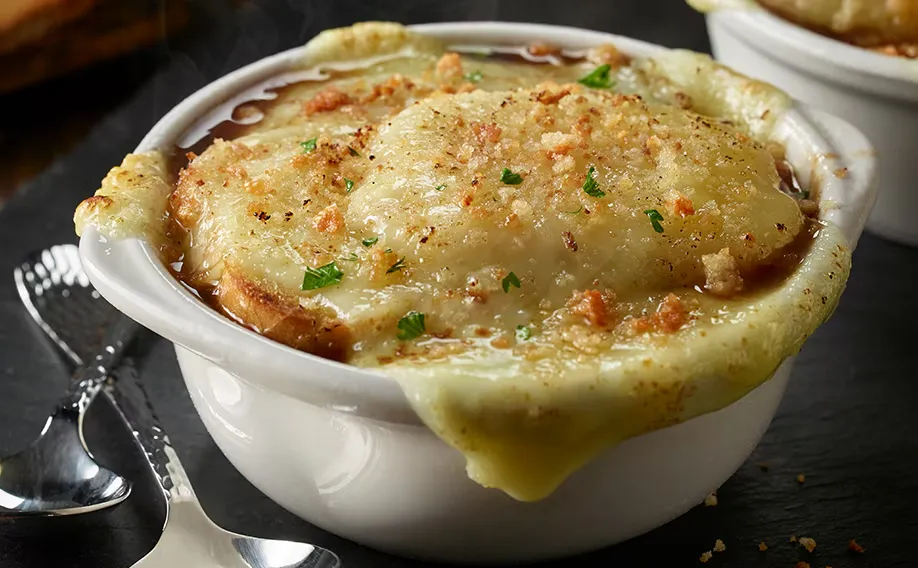
French onion soup is one of those dishes that sounds boring written on a menu and then completely flips your expectations once it shows up at the table. A small crock of dark broth, a mound of slow-cooked onions underneath, a thick slice of toasted baguette floating on top, and a lid of melted, browned Gruyère cheese pulled straight from the broiler. That’s it. No fancy garnish, no trendy upgrade. And yet people who order it once end up looking for it on every menu for the rest of their lives.
This guide breaks down what French onion soup actually is, what goes into it, how it tastes, how many calories you’re dealing with, what cheese sits on top, how to eat it the right way, and what to drink or eat alongside it. Whether you’re trying it for the first time at a French bistro, ordering it at The Cheesecake Factory tonight, or just curious why this 200-year-old dish refuses to leave restaurant menus, you’ll find the answer here.
What Is French Onion Soup?
French onion soup is a traditional French dish made with onions cooked low and slow in butter until they turn deep brown and sweet, then simmered in beef broth with herbs and a splash of wine. It’s served in a small oven-safe crock, topped with a toasted baguette slice and a thick layer of melted Gruyère cheese broiled until it browns and bubbles.
The proper French name is soupe à l’oignon gratinée. The word “gratinée” refers to the cheese-and-broiler finish, and that’s the version almost every American restaurant serves. Without the broiled cheese top, it’s just onion soup. With it, it becomes the dish people actually crave on cold nights.
A Brief History of French Onion Soup
The dish traces back to at least 18th-century France as a cheap working-class meal, onions, stale bread, and broth stretched into something filling. One popular legend credits Stanislas Leszczyński, the exiled Polish king and father-in-law of Louis XV, who supposedly invented the modern version after being served a humble bowl during a stay in Champagne. Whether true or not, the story sticks.
The modern broiled-cheese version became famous in the bistros around Les Halles, the old central food market in Paris, where workers and late-night diners would warm up with it after long shifts. Auguste Escoffier, the legendary French chef, helped codify the recipe in classical French cuisine. Julia Child later brought it to American home kitchens through her cookbooks and TV shows. From there it spread to steakhouses, French bistros, and chains like Panera Bread, Outback, and Mimi’s Café across the U.S.
Main Ingredients in French Onion Soup
Six ingredients carry the whole bowl. Get them right and the soup is incredible. Skip any one of them and it falls apart.
Yellow onions. The base of everything. Most kitchens use yellow or Vidalia onions because they caramelize better than red or white varieties. They’re sliced thin and cooked in butter for 45 minutes to over an hour until they collapse into a dark, jammy mass. This is the Maillard reaction doing the heavy lifting, sugars and amino acids breaking down into deep flavor.
Butter. What the onions cook in. A lot of recipes add a splash of olive oil so the butter doesn’t burn during the long caramelization.
Beef broth or stock. The liquid base. A few French recipes mix beef and chicken stock, but beef is what gives the soup its color and depth. Restaurant versions usually start with a real bone broth or demi-glace, not a powder.
Dry white wine, sherry, or Cognac. Added after the onions caramelize and before the broth goes in. It deglazes the pan, lifts the browned bits, and gives the soup a slight tang under all the sweetness.
Baguette. Sliced thick, toasted hard, then floated on top of the soup. The toast has to be sturdy enough to hold up the cheese without sinking and turning to mush. Stale bread actually works better than fresh.
Gruyère cheese. Shredded or sliced over the bread, then broiled. Gruyère is a Swiss cheese with a nutty, slightly sharp flavor that melts beautifully and browns without turning rubbery. Some kitchens blend it with Emmental, Comté, or Provolone for extra pull and stretch.
Aromatics like thyme, bay leaf, and a clove or two of garlic round out the broth. A dash of Worcestershire sauce sometimes shows up in American versions for extra umami.
Ingredient Substitutions
| Traditional Ingredient | Common Substitute | Notes |
|---|---|---|
| Gruyère | Swiss, Emmental, Comté, Provolone | Swiss melts similarly; Provolone gives more pull |
| Beef broth | Mushroom stock + soy sauce | For a vegetarian version |
| Dry white wine | Sherry, dry vermouth, or extra broth | Skip wine entirely if needed |
| Baguette | Sourdough, ciabatta, French bread | Must be sturdy enough to hold cheese |
| Yellow onions | Vidalia, sweet onions | Avoid red color and flavor change |
| Butter | Olive oil + small butter pat | Helps prevent burning |
Taste and Flavor Profile of French Onion Soup
French onion soup tastes savory, slightly sweet, and rich, three things going at once.
The onions, after that long slow cook, lose their sharp bite completely. What’s left is a deep, almost caramel sweetness. That’s the foundation. On top of it sits the beef broth, which adds salt and a meaty, umami pull. The wine cuts through both with just enough acid to keep the soup from getting cloying.
The cheese on top changes the whole experience. Once you break through the broiled crust with your spoon, you get melted Gruyère stretching out, soaked bread underneath, and the broth pulling everything together in one bite. It’s salty, gooey, sweet, and warm all at once.
It’s not a light soup. People sometimes describe it as “meaty without the meat,” which is the most honest way to put it. If you don’t like sweet onions or rich, brothy dishes, this probably isn’t your bowl. If you do, almost nothing else on a restaurant menu hits the same way.
Nutritional Information and Calories in French Onion Soup
The calorie count depends entirely on how much cheese and bread sit on top. A standard restaurant cup of French onion soup usually lands in this range:
| Nutrient | Approx. per serving (1 cup / ~245g) |
|---|---|
| Calories | 350–450 |
| Total fat | 18–25 g |
| Saturated fat | 10–14 g |
| Carbohydrates | 25–35 g |
| Protein | 14–20 g |
| Sodium | 1,100–1,700 mg |
| Fiber | 2–4 g |
| Sugar | 6–10 g (mostly from caramelized onions) |
A few things worth knowing before you order:
Sodium is the big number. Beef broth plus melted cheese plus salted bread stacks up fast. The FDA’s daily sodium recommendation is 2,300 mg, and a single bowl can hit 70% of that. If you’re managing blood pressure, this is one of the heaviest hitters on most menus.
Protein mostly comes from the cheese, not the broth. Versions with extra Gruyère push protein up but also push saturated fat up with it.
It’s not gluten-free in the traditional form (the baguette), and it’s not vegetarian in most restaurants (beef broth). Some kitchens offer a vegetarian version with mushroom or vegetable stock, but it’s a different soup at that point.
Why People Love French Onion Soup
It hits a craving that almost nothing else on the menu does. Hot, salty, cheesy, and rich, but still technically a soup, which makes it feel acceptable to order as a starter instead of an entrée.
The bigger draw is texture. Most soups give you one consistency the whole way through. French onion soup gives you four: the crisp browned cheese crust, the soft melted layer underneath, the soaked bread, and the broth at the bottom. Every spoonful feels different.
There’s also the theater of it. The crock comes out steaming, the cheese still bubbling. You break through the top with your spoon and the cheese pulls. It’s one of the few appetizers that looks better in person than in any photo.
And in the U.S., it’s become a comfort food more than a French dish. People order it on cold nights, after a long day, at airports, at chain restaurants on a random Tuesday. It travels well across contexts because it’s warm, filling, and familiar.
How to Eat French Onion Soup the Right Way
There’s no formal etiquette, but a few moves make the experience better:
- Wait two to three minutes. The broth holds extreme heat under the cheese layer. People burn their mouths on this soup more than any other appetizer.
- Break the cheese crust with the edge of your spoon, not by stabbing it. Pressing down sideways gives a cleaner break and keeps the bread intact.
- Lift slowly, let the cheese pull and trail back into the bowl. That stretch is half the experience.
- Scoop bread, cheese, and broth in the same spoonful. The combination is the entire point. Eating the layers separately misses what makes the dish work.
- Use the soup spoon, not a regular spoon. Most restaurants serve it with a deeper, rounded one for a reason: it handles broth and cheese better.
- Don’t add salt. Almost every restaurant version is already at the upper limit of seasoning. Taste it first.
Best Side Dishes and Drink Pairings for French Onion Soup
French onion soup is rich, so the best sides keep things simple and a little acidic to balance the cheese and broth.
Sides that work well
- A simple green salad with a sharp vinaigrette arugula, frisée, or endive. The acid cuts the richness.
- A small charcuterie board for sharing.
- Steak frites, if you’re treating the soup as an appetizer. This is the classic French bistro combo.
- Roast chicken or half a rotisserie.
- A croque monsieur or a simple grilled cheese for full comfort-food mode.
- Crusty bread with butter, even though there’s already bread in the soup.
Drink pairings
- Red wine. A medium-bodied Pinot Noir or Beaujolais is the classic pick. Both are light enough not to fight the broth.
- White wine. A dry Riesling or unoaked Chardonnay works if you prefer white. Skip the buttery, oaky Chardonnays, too much going on.
- Dry sherry or Madeira. Some people drink sherry alongside the soup, especially if the recipe uses it.
- Beer. A Belgian dubbel, a brown ale, or a darker lager pairs well with the caramelized onion flavor.
- Non-alcoholic. Sparkling water with lemon is the best palate cleanser. Hot black coffee at the end works well in winter.
Skip anything sweet or fruity it clashes with the savory depth.
When to order it
- Best season: Fall and winter (October through February)
- Best occasions: Date nights, post-ski meals, holiday dinners, business lunches at steakhouses
- Best time of day: Dinner appetizer or late-night bistro meal too heavy for breakfast or light lunch
Variations and Popular Versions
The traditional French version is the standard, but most American restaurants have their own spin.
Classic French (Lyonnaise-style gratinée). Yellow onions, beef stock, dry white wine, Gruyère, baguette. The original Julia Child taught American home cooks.
American steakhouse version. Often uses a darker beef broth, sometimes with a splash of Worcestershire or Cognac. The cheese is usually a blend of Gruyère, mozzarella, and Provolone for extra pull.
Vegetarian French onion soup. Made with mushroom stock or a strong vegetable broth, sometimes finished with soy sauce or miso to mimic the umami of beef stock.
Slow cooker French onion soup. Popular for home cooks. The onions caramelize for 8 to 10 hours instead of one. Softer texture, similar flavor.
Modern bistro takes. Some restaurants finish the soup with a touch of port, Madeira, or red wine instead of white. Others add a small pour of Cognac at the end.
French Onion Soup at Popular U.S. Chains
| Restaurant | Cheese Used | Calories (approx.) | Price Range | Notable Detail |
|---|---|---|---|---|
| The Cheesecake Factory | Gruyère + mozzarella blend | ~480 | $9–11 | Sweeter, thick cheese crust |
| Outback Steakhouse | Provolone + mozzarella | ~510 | $7–9 | Saltier, heavier broth |
| Panera Bread | Asiago + Parmesan croutons | ~250 | $7–8 | Lighter, served with croutons not baguette |
| Mimi’s Café | Swiss + Provolone | ~430 | $8–10 | Closest to French bistro style |
| Houlihan’s | Gruyère + Swiss | ~440 | $8–10 | Known for extra-cheesy top |
Prices and calorie counts may vary by location and season. Confirm with the restaurant before ordering.
Tips Before Ordering French Onion Soup
A few things worth knowing before the bowl shows up.
Check the broth base. If you’re vegetarian, ask. Most kitchens default to beef stock without mentioning it.
Give it a minute. Cheese-topped soup is genuinely dangerous if you dig in too fast the broth underneath holds heat way longer than it looks.
Look at the cheese crust. A good French onion soup has cheese that’s browned on top and pulls when you lift the spoon. If it looks pale and flat, the broiler step got rushed.
Mind the sodium if you have blood pressure issues. This is one of the saltiest items on most menus. Order a cup instead of a bowl if it’s offered.
Don’t pair it with another heavy starter. It’s filling. If you’re ordering an entrée, the soup is enough on its own.
Eat it fresh. French onion soup doesn’t reheat well at home. The bread turns to paste and the cheese gets rubbery. Order it for the meal you’re at, not for takeout if you can avoid it.
Bring an appetite. Even a “cup” portion is heavier than most soups because of the cheese and bread.
Chef’s Notes
- Real French bistros caramelize onions for 60–90 minutes, not 20. If a recipe says “20 minutes to caramelize,” it’s wrong.
- Stale bread holds up better than fresh, it soaks broth without disintegrating.
- Always toast the baguette twice: once before topping, once under the broiler with the cheese.
- A splash of apple cider vinegar or balsamic at the end brightens the broth without anyone tasting vinegar.
- The crock matters. A wide, shallow ramekin gives more cheese surface area which is why steakhouse versions look so dramatic.
- A pinch of sugar added during caramelization is a common bistro shortcut to deepen the color when time is short.
Frequently Asked Questions About French Onion Soup
Is French onion soup actually French?
Yes. It traces back to at least 18th-century France as a cheap working-class meal of onions, stale bread, and broth. The modern broiled-cheese version, soupe à l’oignon gratinée, became famous in Paris bistros near Les Halles market in the 1800s.
What kind of cheese is on French onion soup?
Traditionally Gruyère is a Swiss cheese that melts smoothly and browns well under a broiler. Some American versions mix in mozzarella, Provolone, or Emmental for stretch and a more dramatic cheese pull.
Is French onion soup healthy?
Not really, in the traditional form. It’s high in sodium and saturated fat from the cheese, butter, and broth. It does have decent protein and the onions themselves are nutrient-dense, but most servings hit 1,100+ mg of sodium.
Can French onion soup be made vegetarian?
Yes, by swapping beef broth for mushroom or vegetable stock. The flavor changes, it’s less meaty, more earthy but a strong stock finished with soy sauce or miso can get close to the original.
How many calories are in a bowl of French onion soup?
Most restaurant servings run 350 to 450 calories per cup, and 500 to 700 for a full bowl. The cheese and bread account for most of that.
Why are the onions in French onion soup brown?
They’re caramelized cooked slowly in butter for 45 minutes or longer until their natural sugars break down into a deep brown color and sweet flavor. That’s the Maillard reaction at work.
What’s the difference between French onion soup and regular onion soup?
Regular onion soup is just onions in broth. French onion soup refers specifically to the version with caramelized onions, a wine base, a slice of toasted baguette on top, and a thick layer of broiled Gruyère.
Can you make French onion soup ahead of time?
The broth and caramelized onions can be made a day or two in advance and actually taste better the next day. The bread and cheese topping has to go on right before serving they don’t store well once soaked.
Conclusion
French onion soup isn’t trying to be light, healthy, or trendy. It’s a bowl of caramelized onions, beef broth, toasted baguette, and broiled Gruyère, and it’s been that exact thing for over 200 years. That’s why it still works. Order it when you want something rich, salty, and hot. Pair it with a glass of Pinot Noir or a simple green salad. Eat it fresh, while the cheese is still pulling. If you only get to try one French dish at a restaurant this year, this is the one that costs the least and delivers the most.
Related LongHorn Guides
Longhorn Loaded Potato Soup: Calories, Prices & Other · LongHorn Fresh Steamed Asparagus: Calories, Pairings & Guide · LongHorn Great Steak Additions: Toppings, Prices & Guide