Molten Lava Cake: A Complete Guide to the Classic Restaurant Dessert
Key Takeaways
- Molten lava cake is an individual chocolate cake with a warm, liquid chocolate center that flows out when you cut into it.
- It was popularized in 1987 by French chef Jean-Georges Vongerichten in New York and has been on American restaurant menus ever since.
- One restaurant serving runs $6.99–$9.99 and around 400–700 calories.
- The cake is technically underbaked on purpose. The gooey center is raw cake batter, not separate sauce.
- Best paired with vanilla ice cream, fresh berries, and a cup of espresso or a glass of port.
- One of the easiest restaurant-quality desserts to make at home, under 30 minutes start to finish.
- Found on menus at Chili’s, Applebee’s, Outback, Roy’s, Domino’s, and most American casual chains.
Introduction
Few desserts have crossed from fine dining to fast food as completely as the molten lava cake. It started at a Michelin-starred restaurant in New York in the late 1980s and now shows up on the menu at Domino’s Pizza, Chili’s, Applebee’s, and almost every American chain restaurant in between. The pitch is simply a small chocolate cake with a warm liquid center that pours out when you cut into it, and somehow that single trick has kept the dessert on menus for nearly 40 years.
This guide breaks down what a molten lava cake actually is, where it came from, what’s in it, how it’s made, how it tastes, how many calories you’re dealing with, and the best places to find it (plus how to make it at home in under 30 minutes). Whether you’re ordering one tonight or trying to figure out why your home version doesn’t ooze, this covers everything you need.
What is a molten lava cake?
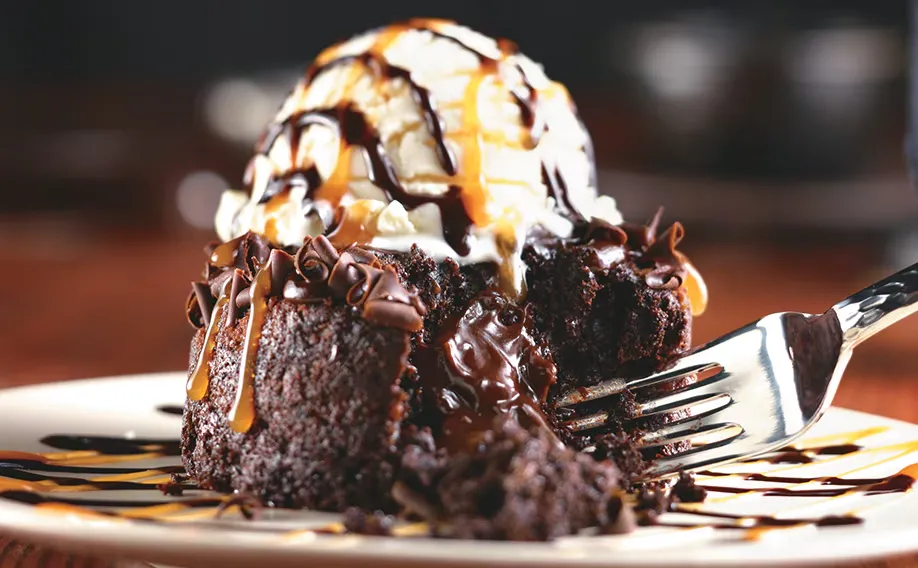
A molten lava cake is a small individual chocolate cake usually baked in a ramekin with a firm cake exterior and a warm, liquid chocolate center that “erupts” when you cut into it. The “lava” name refers to the visual moment when the molten center flows out onto the plate.
The cake itself is a rich chocolate sponge made from dark chocolate, butter, eggs, sugar, and a small amount of flour. The trick is in the baking time; the cake is pulled from the oven just before the center fully sets, leaving the middle as a warm, gooey, semi-liquid chocolate batter. The exterior continues to firm up as it cools slightly, while the center stays molten.
A few facts about molten lava cake that surprise most diners:
- The “lava” isn’t a separate sauce poured in. It’s the same cake batter, underbaked on purpose.
- A properly made molten lava cake is technically underbaked, not raw. The eggs are partially cooked by residual heat.
- It’s served warm directly from the oven, usually within minutes of baking.
- It’s traditionally served in or on the same ramekin it was baked in, then either inverted onto a plate or left in the dish.
The classic version is finished with a dusting of powdered sugar, a scoop of vanilla ice cream, fresh berries, and sometimes a drizzle of raspberry coulis.
Where Did Molten Lava Cake Come From?
This is one of the rare desserts with a documented origin story, though there’s some friendly debate about who actually invented it.
The widely credited version starts with Jean-Georges Vongerichten, the French-American chef who introduced the dessert at his New York restaurant Jean Georges in 1987. His story is straightforward: a chocolate sponge cake came out of the oven undercooked, he tasted it, realized the warm liquid center was the best part, and put it on the menu intentionally. The dessert became a hit and spread across American fine dining throughout the 1990s.
The competing claim comes from Michel Bras, the legendary French chef from Laguiole, France, who created a similar dessert called the Coulant au Chocolat in 1981, six years before Vongerichten’s version. Brás’s coulant was a baked cake with a frozen ganache center placed inside before baking, which melted into a flowing chocolate center as the cake cooked around it. The two desserts arrive at a similar result through completely different techniques.
Most food historians credit Bras with the original concept and Vongerichten with popularizing the dessert in the United States. Both deserve credit for different reasons.
By the late 1990s, the dessert had escaped fine dining entirely. Chili’s put their Molten Chocolate Cake on the menu in 1995, and it remained one of their most-ordered desserts for over 25 years. Domino’s added a version in 2009 that turned the dessert into a delivery menu staple. Olive Garden, Applebee’s, Roy’s, and P.F. Chang’s all run their own versions today.
Main Ingredients
The ingredient list is short, but each component matters. A molten lava cake is one of those desserts where the quality of the ingredients shows directly in the final result.
Dark chocolate. The flavor foundation. Most recipes use semi-sweet (60-70% cacao) or bittersweet (70%+) chocolate. Higher-quality chocolate brands like Valrhona, Callebaut, or Ghirardelli produce a noticeably better cake than baking chips. Avoid chocolate chips designed for cookies; they contain stabilizers that prevent smooth melting.
Unsalted butter. Equal weight to the chocolate in most recipes. The butter melts into the chocolate to create the rich base that makes the cake feel luxurious.
Eggs and egg yolks. Whole eggs give structure; extra yolks add richness and that signature glossy texture. Most recipes call for 2 whole eggs plus 2 yolks for 4 servings.
Granulated sugar. Sweetens the cake and helps create a slight crust on the exterior.
All-purpose flour. Just a small amount, usually 2–3 tablespoons per 4 servings. The low flour content is what allows the center to stay liquid. Too much flour and you get a regular chocolate cake.
Salt. Kosher salt enhances the chocolate flavor. Just a pinch.
Vanilla extract (optional). Adds depth.
Espresso powder (optional). A common chef’s trick is to use a small amount of instant espresso powder to enhance the chocolate without making the cake taste like coffee. About 1/4 teaspoon for 4 servings.
For serving
- Powdered sugar (dusted on top)
- Vanilla bean ice cream
- Fresh raspberries or strawberries
- Mint sprig
- Raspberry coulis or chocolate sauce drizzle
That’s the entire ingredient list. Eight or nine ingredients, no special equipment, and a result that looks impressive.
How Molten Lava Cake Is Made
There are two main techniques used to make molten lava cake, and the difference matters for both home cooks and restaurants.
Method 1: The Underbake Method (Vongerichten Style)
This is the most common method in American restaurants and at home. The whole cake batter goes into the ramekin, and the cake is intentionally pulled from the oven before the center cooks through.
Process
- Melt chocolate and butter together over a double boiler or in the microwave.
- Whisk eggs, egg yolks, and sugar until thick and pale.
- Fold the melted chocolate mixture into the egg mixture.
- Sift in flour and salt; gently fold.
- Pour into buttered, floured ramekins.
- Bake at 425°F for 9–12 minutes until the edges are firm but the center still jiggles slightly.
- Cool for 1 minute, invert onto a plate, serve immediately.
The timing is everything. 9 minutes = too liquid. 12 minutes = no lava. Most home ovens need 10–11 minutes for a perfect result. Use a timer.
Method 2: The Frozen Ganache Method (Bras Style)
This is the technique used in more refined kitchens and by serious home bakers who want consistent results.
Process
- Make a chocolate ganache (heavy cream and chocolate).
- Freeze the ganache in small balls or cubes.
- Make a regular chocolate cake batter.
- Place a frozen ganache ball in the center of each ramekin filled with batter.
- Bake until the cake is fully set but the ganache center is just melted.
The advantage of this method is consistency. Even if you slightly overbake, the frozen ganache melts into a liquid center reliably. The disadvantage is more prep work.
Most chain restaurants use a hybrid version, where they make the cakes ahead of time, freeze them, and finish baking each individual cake when ordered. This is how Chili’s, Applebee’s, and others can serve molten lava cakes within 10 minutes of ordering.
Taste and Flavor Profile
A properly made molten lava cake tastes rich, deep, and intensely chocolatey, with a contrast between two distinct textures in every bite.
The exterior is the first thing you taste, a slightly firm chocolate sponge with a subtle crust on top from the powdered sugar and the brief oven exposure. It’s similar to a brownie’s edge texture but lighter.
The center is the moment. When you cut in with a spoon, the molten chocolate flows out onto the plate. The temperature is warm but not hot. The texture is smooth, almost like a chocolate sauce, but slightly thicker because it’s still cake batter. The flavor is more concentrated than the cake itself, pure dark chocolate, slightly sweet, slightly bitter.
The temperature contrast is what makes the dessert work. The warm cake plays against the cold vanilla ice cream and the cool raspberries. That hot-cold combination is the same principle behind sundaes, pie à la mode, and other classic warm-and-cold desserts.
The flavor balance is more refined than most chain desserts. There’s bitterness from the dark chocolate, sweetness from the sugar, richness from the butter and eggs, and brightness from the berries or coulis. It’s not a one-note dessert.
It’s a dessert that rewards quality ingredients. A lava cake made with cheap chocolate chips tastes flat and overly sweet. The same cake made with Valrhona or good Ghirardelli tastes like something you’d find at a restaurant charging $12 a slice.
Molten Lava Cake at U.S. Chains
Here’s how the most popular American chain versions compare in 2026.
| Restaurant | Price | Approx. Calories | Notable Detail |
|---|---|---|---|
| Chili’s (Molten Chocolate Cake) | $6.99 – $8.99 | 1,070 | Original chain version since 1995, served with ice cream |
| Applebee’s (Triple Chocolate Meltdown) | $7.99 – $9.99 | 800 – 1,000 | Hot fudge and white chocolate drizzles |
| Outback Steakhouse (Chocolate Thunder from Down Under) | $11.99 – $13.99 | 1,400 – 1,600 | Brownie + ice cream + chocolate sauce |
| Roy’s Restaurant (Original Hot Chocolate Soufflé) | $13.99 – $16.99 | 700 – 900 | Considered the gold standard restaurant version |
| P.F. Chang’s (Great Wall of Chocolate) | $10.99 – $12.99 | 1,300 – 1,500 | Layered cake, not technically lava but often confused |
| Olive Garden (Black Tie Mousse Cake) | $9.99 – $11.99 | 800 – 1,000 | Layered, not truly molten |
| Domino’s (Chocolate Lava Crunch Cake) | $4.99 – $6.99 (2 per order) | 350 per cake | Delivery favorite, two cakes per box |
| Cheesecake Factory (Hot Fudge Sundae) | $11.99 – $13.99 | 1,500+ | Different category but similar warm-cold concept |
| IHOP (Chocolate Lava Cake) | $7.99 – $9.99 | 600 – 800 | Breakfast-friendly version |
Best overall chain version: Roy’s. Best value: Chili’s. Best delivery: Domino’s (two cakes for the price of one chain dessert). Best for sharing: Outback’s Chocolate Thunder, though it’s not technically a lava cake.
Prices and calorie counts vary by location and season. Confirm current pricing on the restaurant’s app or menu.
Calories and Nutrition
The nutritional profile varies significantly between restaurant versions and homemade versions. Restaurant portions are usually much larger and include ice cream and toppings.
| Nutrient | Standard restaurant serving (single cake with ice cream) |
|---|---|
| Calories | 700 – 1,100 |
| Total fat | 35 – 55 g |
| Saturated fat | 18 – 30 g |
| Carbohydrates | 85 – 125 g |
| Sugar | 65 – 95 g |
| Protein | 7 – 12 g |
| Sodium | 200 – 400 mg |
| Cholesterol | 150 – 220 mg |
| Fiber | 3 – 6 g |
A few things worth knowing:
Sugar is the dominant macro. Between the cake, the powdered sugar, the ice cream, and any sauce, you’re looking at over 60g of sugar in a standard restaurant version. The American Heart Association recommends a daily limit of 36g for men and 25g for women.
The cake alone (without ice cream) runs 400–600 calories meaningful for diners who want to skip the toppings.
Saturated fat runs high because of butter, chocolate, and ice cream.
Homemade portions are often smaller, typically 300–450 calories per cake without ice cream, because home cooks usually make 4 servings from one recipe instead of one giant restaurant portion.
Sharing changes everything. Split a Chili’s Molten Chocolate Cake between 2 people, and the per-person calorie count drops to 500, closer to a reasonable dessert portion.
Not safe for raw egg concerns. The center is partially cooked but the eggs aren’t fully set. Pregnant women, immunocompromised people, and young children should avoid molten lava cake or order one made with the frozen ganache method.
Why People Love Molten Lava Cake
There’s a reason this dessert has stayed on menus for decades.
The visual moment is unbeatable. Cutting in with a spoon and watching the warm chocolate flow out is a dessert experience few other items match. People photograph it. They send videos of it. It’s built for the modern Instagram-and-TikTok era despite being invented decades before either existed.
The flavor is universal. Chocolate is the most universally loved dessert flavor in America. A warm, deeply chocolatey single-serving cake hits almost everyone’s preferences.
It feels special even when it’s not. Whether you order it at a Michelin-starred restaurant or get it delivered with a Domino’s pizza, the dessert feels like an event.
It’s individual. No splitting, no awkward serving. Each diner gets their own cake.
The temperature contrast works. Warm cake plus cold ice cream is one of the most universally satisfying dessert pairings in pastry.
It’s fast. Restaurant versions arrive in 5–10 minutes. Home versions take 30 minutes total.
It scales. From $4.99 at Domino’s to $16.99 at Roy’s, the dessert works at every price point.
It’s photogenic. The dramatic spill of liquid chocolate when you cut into it is one of the most-photographed dessert moments in casual dining.
For occasions like dates, anniversaries, and birthdays, the molten lava cake remains a default order because it almost always works.
Best Pairings for Molten Lava Cake
The right pairing transforms a good dessert into a great one.
Best toppings
- Vanilla bean ice cream. The classic. The cold cream contrasts perfectly with the warm chocolate.
- Fresh raspberries or strawberries. Bright acidity cuts through the richness.
- Raspberry coulis. Concentrated berry flavor in a sauce form.
- Whipped cream. Lighter alternative to ice cream.
- Salted caramel sauce. Sweet-salty pairing that’s increasingly popular.
- Powdered sugar. Always. The dusting is part of the look.
- Fresh mint sprig. Visual brightness and a subtle flavor lift.
Best drink pairings
- Black coffee or espresso. The most classic pairing. Bitter coffee enhances the chocolate.
- Cappuccino or latte. The milky version works just as well.
- Port wine. The traditional dessert wine pairing for chocolate.
- Cabernet Sauvignon. Full-bodied red that handles chocolate beautifully.
- Pinot Noir. Lighter option that still works.
- Bourbon on the rocks. Caramel-vanilla notes echo the dessert.
- Bailey’s Irish Cream. Doubles the richness for serious chocolate fans.
- Cold whole milk. The childhood classic. Still works.
- Hot chocolate. Doubles down on chocolate.
Best food meal that leads into it
- A lighter entrée, grilled fish or chicken, saves room for the rich dessert.
- Avoid pairing with another heavy chocolate dish in the meal.
- A green salad or vegetable-forward main is the ideal lead-in.
Skip overly sweet wines, light beers, and citrusy cocktails; they fight the chocolate rather than complementing it.
How to Make Molten Lava Cake at Home
This is one of the easiest restaurant-quality desserts to make at home. Total time: under 30 minutes from start to plate. It’s the perfect last-minute dessert.
You’ll need (serves 4)
- 6 oz high-quality dark chocolate (60–70% cacao), chopped
- 1/2 cup (1 stick) unsalted butter
- 2 large eggs
- 2 large egg yolks
- 1/4 cup granulated sugar
- 2 tablespoons all-purpose flour
- 1/4 teaspoon kosher salt
- 1/4 teaspoon espresso powder (optional but recommended)
- 1 teaspoon vanilla extract
- Butter and cocoa powder, for greasing ramekins
- Powdered sugar, for dusting
- Vanilla bean ice cream and fresh berries, for serving
The method
- Prep the ramekins. Generously butter four 6-ounce ramekins, then dust with cocoa powder (not flour, as flour leaves a white residue). Tap out excess.
- Preheat oven to 425°F. This is the right temperature; high heat sets the exterior fast while leaving the center molten.
- Melt the chocolate and butter. In a microwave-safe bowl, microwave in 30-second intervals, stirring between, until smooth. Or use a double boiler. Cool slightly.
- Whisk eggs and sugar. In a separate bowl, whisk eggs, egg yolks, sugar, and salt until thick, pale, and doubled in volume about 2–3 minutes.
- Combine. Pour the chocolate mixture into the egg mixture and whisk to combine. Add vanilla and espresso powder.
- Fold in flour. Sift the flour over the batter and gently fold until just combined. Don’t overmix.
- Fill ramekins. Divide batter evenly between the four prepared ramekins. Fill about 3/4 full.
- Bake for 10–12 minutes. The edges should be firm and starting to pull away from the ramekin, while the center should still look slightly soft and shiny. Set a timer. This is the critical step.
- Cool for 1 minute. Then run a knife around the edge of each cake, place a plate over the top, and invert. Lift the ramekin away carefully.
- Serve immediately. Dust with powdered sugar, add a scoop of vanilla ice cream, scatter berries, and serve.
Pro tip: You can make the batter up to 24 hours in advance. Fill the ramekins, cover, and refrigerate. Add 2–3 minutes to the bake time when baking from cold.
Common mistakes to avoid
- Overbaking by 1 minute = no lava. Trust the timer.
- Underbaking by 1 minute = wet batter, not molten. Trust the timer.
- Cheap chocolate = flat flavor. Use real bar chocolate, not chips.
- Not greasing properly = stuck cake. Butter generously and use cocoa powder, not flour.
- Skipping the powdered sugar. It’s not optional, it’s part of the presentation.
The home version is almost always better than the chain version because you control the chocolate quality and serving temperature.
Molten Lava Cake Variations
The classic chocolate version is just the starting point. Pastry chefs and home bakers have run with the concept in dozens of directions.
- Salted caramel lava cake. A salted caramel center instead of chocolate, often inside a chocolate cake exterior.
- Peanut butter lava cake. A peanut butter ganache center inside chocolate cake. The Reese’s of desserts.
- White chocolate lava cake. White chocolate center inside dark chocolate cake, strong contrast in color and flavor.
- Nutella lava cake. Nutella center inside chocolate or hazelnut cake.
- Matcha lava cake. Green tea-flavored cake with a white chocolate or matcha center. Popular in Asian-inspired restaurants.
- Red velvet lava cake. Red velvet cake with a cream cheese center.
- Pumpkin spice lava cake. Seasonal fall version with a spiced filling.
- Mocha lava cake. Coffee-spiked chocolate cake with an espresso ganache center.
- Raspberry lava cake. Chocolate cake with a raspberry compote or white chocolate-raspberry center.
- Gluten-free lava cake. Made with almond flour or a gluten-free flour blend. The texture stays similar.
- Vegan lava cake. Made with coconut oil, plant-based milk, and aquafaba instead of eggs. Texture is slightly different but the molten center still works.
- Mini lava cakes. Made in smaller cupcake-sized ramekins or muffin tins. Bake time drops to 6–8 minutes. Great for parties.
- Skillet lava cake (giant version). Made in a cast iron skillet for sharing. Bake time increases to 18–22 minutes.
How to Order Molten Lava Cake at Restaurants
A few tips that make the experience noticeably better.
Order it at the start of dessert, not after. It takes 5–10 minutes to bake. Ordering early prevents waiting.
Ask for the ice cream on the side. Some kitchens put the ice cream directly on the cake, which melts too fast. Side-served ice cream stays cold longer.
Pair with coffee. Order coffee or espresso to arrive with the dessert. Best pairing.
Ask for extra berries. Most kitchens will add them at no charge.
Don’t reheat leftovers in the microwave. The center turns hard and the lava effect is gone. If you must reheat, do it in a 350°F oven for 3–5 minutes.
Order it warm. If your cake arrives lukewarm rather than hot, send it back. The temperature is the whole point.
Cut from the center. Going in with a spoon from the side, not the top, gives you the best initial lava flow.
Pro Tips from Regulars
- At Chili’s, the 3 for Me combo often includes the Molten Chocolate Cake, the best value in the category at under $14 for a full meal.
- At Domino’s, the Chocolate Lava Crunch Cakes come two per order the best dessert deal in delivery food.
- At Roy’s, request the Chocolate Soufflé with the “vanilla bean ice cream upgrade,” significantly better than the standard scoop.
- At home, freezing the cakes uncooked (in their ramekins, wrapped tight) means you can bake one whenever you want a dessert in under 15 minutes.
- For dinner parties: prep ramekins in advance, store batter in the fridge for up to 24 hours, and bake at the table during dessert.
Frequently Asked Questions
What is molten lava cake?
A small individual chocolate cake with a warm, liquid chocolate center that flows out when you cut into it. The center is intentionally underbaked cake batter, not separate sauce.
Who invented molten lava cake?
The two most commonly credited chefs are Michel Bras (France, 1981, with the Coulant au Chocolat) and Jean-Georges Vongerichten (New York, 1987, with the version that popularized the dessert in America).
Is molten lava cake safe to eat?
For most healthy adults, yes. The eggs are partially cooked by residual heat. Pregnant women, immunocompromised people, and young children should avoid the underbaked version. The frozen ganache method is safer because the eggs are fully baked.
How many calories are in a molten lava cake?
A homemade cake without ice cream runs 300–450 calories. A restaurant serving with ice cream runs 700–1,100 calories. Chili’s version with ice cream is around 1,070 calories.
What’s the difference between a molten lava cake and a brownie?
A brownie is fully baked and uniform in texture. A molten lava cake is intentionally underbaked in the center to create a liquid chocolate flow. Brownies are denser and chewier; lava cakes have lighter cake exteriors and gooey centers.
Can you make molten lava cake without flour?
Yes, flourless chocolate lava cakes are a popular gluten-free version. The texture is denser and the cake more fudge-like, but the molten center still works.
Can you make molten lava cake ahead of time?
Yes. Fill the ramekins with batter, cover tightly, and refrigerate for up to 24 hours or freeze for up to 1 month. Add 2–4 minutes to the bake time when baking from cold.
What’s the best chocolate for molten lava cake?
Quality dark chocolate (60–70% cacao) from brands like Valrhona, Ghirardelli, Callebaut, or Lindt. Avoid chocolate chips designed for cookies; they contain stabilizers that prevent smooth melting.
Why didn’t my lava cake have lava?
The most common reason is overbaking. Pull the cakes 1–2 minutes earlier next time. The edges should be set but the center should still jiggle when you gently shake the ramekin.
Why is my lava cake liquid all the way through?
The opposite issue is underbaking. The exterior didn’t have time to set into the cake. Bake 1–2 minutes longer next time.
How long do you bake a molten lava cake?
At 425°F in a standard 6-ounce ramekin, 10–12 minutes is the sweet spot. Smaller ramekins need 6–8 minutes; larger ones need 13–15 minutes. Always use a timer.
Which restaurant has the best molten lava cake?
Roy’s Restaurant’s Original Hot Chocolate Soufflé is considered the gold standard among chains. Chili’s is the most popular and most consistent at a casual dining price point. Home versions made with high-quality chocolate often beat both.
Conclusion
The molten lava cake remains one of the smartest desserts on any restaurant menu, built from a single trick that’s been working for almost 40 years. A warm chocolate cake with a liquid center that flows out when you cut in, served with cold vanilla ice cream and fresh berries. Whether you’re ordering it at Roy’s for a special occasion, at Chili’s after a casual dinner, getting it delivered with a Domino’s pizza, or making it at home in 30 minutes, the formula doesn’t change: quality dark chocolate, careful timing, and the right temperature contrast. Order it with a cup of black coffee or a glass of port, and don’t reheat the leftovers in the microwave. That’s the dessert that earned its decades-long run on American menus.
Related LongHorn Guides
LongHorn Chicken Tenders: Price, Calories, Taste & Other · LongHorn Chocolate Stampede: Price, Calories, Ingredients & Other · LongHorn Strawberries & Cream Shortcake: Ingredients & Other