Half-Pound Steakhouse Cheeseburger: What’s Actually on It, What It Tastes Like, and What to Order It With
Introduction
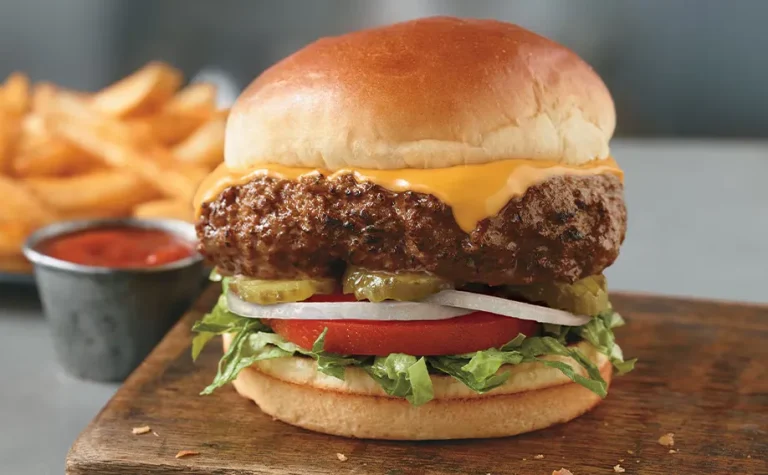
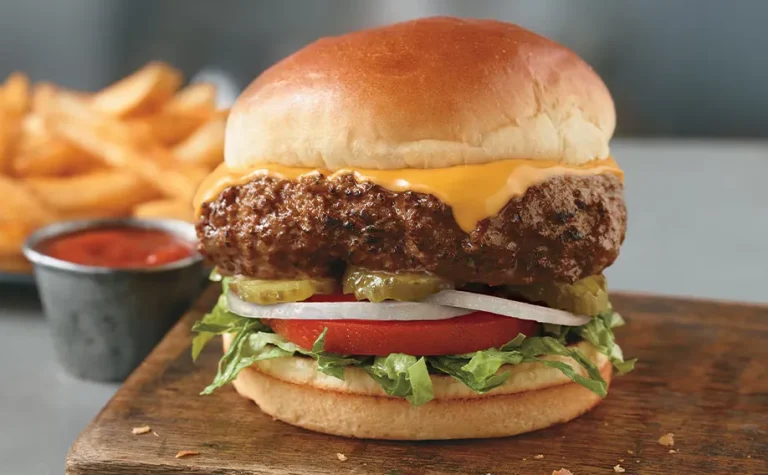
The half-pound steakhouse cheeseburger is the order you make when you walked into a steakhouse hungry but the $34 ribeye made you flinch. Eight ounces of seasoned beef on a toasted brioche bun, a slice of melted American cheese, and a pile of thick-cut steak fries on the side. It’s not trying to be a smashburger. It’s not trying to be a gourmet diner stack. It’s a steakhouse cheeseburger, which means the same kitchen, the same grill, and the same seasoning that goes on a Flo’s Filet is going onto your patty too.
If you’ve been eyeing this thing on a LongHorn, Outback, or Black Angus menu and wondering what you actually get for the price, here’s a full breakdown. What’s in it, what it tastes like, what the calories look like, what to drink with it, and a few small things that are worth knowing before you order.
Quick Facts
| Detail | Info |
|---|---|
| Patty Size | 8 oz raw / ~6 oz cooked |
| Calories (burger only) | 880–950 kcal |
| Protein | 46–52 g |
| Price Range (2026) | $13–$16 with standard side |
| Default Cheese | American |
| Default Bun | Toasted brioche |
| Cooking Method | Char-grilled |
| Default Side | Thick-cut steak fries |
| Best Drink Pairing | Lager beer or sweet tea |
| Meal Category | Lunch / Dinner handheld entrée |
| Available At | LongHorn, Outback, Black Angus, Applebee’s, Texas Roadhouse |
What Is a Half-Pound Steakhouse Cheeseburger?
A half-pound steakhouse cheeseburger is an 8-ounce ground beef patty (raw weight, half a pound) seasoned with a steakhouse-style salt and pepper blend, grilled over an open flame, and served on a toasted brioche bun with cheese and classic burger toppings. The “steakhouse” tag isn’t marketing fluff. It actually means something in this context: the patty gets the same dry rub, the same char-grill, and the same attention as the steaks on the menu.
It cooks down to roughly 6 ounces, which is still bigger than what you’d get from any fast-food chain. Compared to a McDonald’s Quarter Pounder, you’re eating roughly twice the beef, and the meat itself is usually a fresh chuck-and-brisket blend instead of a frozen patty.
What’s on a standard build at most US steakhouse chains:
- 8 oz seasoned ground chuck patty (80/20 blend)
- Slice of American cheese (cheddar, Swiss, pepper jack, and bleu cheese are common swaps)
- Crisp iceberg or green leaf lettuce
- Thick-cut beefsteak tomato slice
- Raw red onion ring
- Dill pickle chips
- Toasted brioche bun (often brushed with garlic butter before toasting)
- Standard side of steak fries
It’s served as a handheld entrée, usually plated with the fries and a small dish of pickle spears or a coleslaw cup, depending on the restaurant.
Main Ingredients
The ingredient list is short, but every piece is doing real work. This is one of those dishes where you can taste the difference when the kitchen is cutting corners, so it’s worth knowing what should be on the plate.
The patty
Ground chuck in an 80/20 blend (80% lean meat, 20% fat) is the steakhouse standard. That fat percentage is non-negotiable for a juicy burger. Drop below it and you get a dry, crumbly patty no matter how skilled the cook is. Most steakhouses grind their own beef or take fresh deliveries, so the meat isn’t sitting frozen in a freezer for weeks. Some chains do a chuck-and-brisket mix for deeper flavor.
The seasoning
A simple dry rub: kosher salt, cracked black pepper, granulated garlic, with paprika and onion powder in some restaurant blends. The same seasoning that goes on the sirloin. Applied right before the patty hits the grill so it forms a salty crust during the cook.
The cheese
American by default, and there’s a real reason for that. American cheese is designed to melt smoothly without breaking into greasy puddles. It coats the patty evenly and tastes good against peppery beef. Cheddar gives you sharpness. Pepper jack adds heat. Bleu cheese is the upgrade for people who want a louder flavor pairing.
The bun
Brioche has become the default steakhouse burger bun for two reasons: it holds up under a heavy juicy patty without falling apart, and the egg-and-butter dough toasts to a beautiful golden color on the flat-top. A garlic butter brush before toasting is a small move that some kitchens make, and you notice it.
The toppings
Nothing fancy. Iceberg or green leaf lettuce for crunch, a slab of ripe tomato, a slice of raw red onion, and dill pickle chips for the acidic snap. Mayo and special sauces are usually served on the side or added on request.
The side
Almost always thick-cut steak fries with the skin on, fried until the outside is crackly and the inside is soft. A few restaurants swap in beer-battered fries or sweet potato wedges.
How the Kitchen Actually Builds It
Watching a steakhouse line cook put this burger together takes about four minutes from start to finish, and the order of operations matters more than people realize.
The patty hits a hot char-grill first, gets pressed once with the back of a spatula to make solid contact (not smashed flat – just pressed), and is left alone to develop a crust for around three minutes per side. The seasoning is applied right before grilling, never mixed into the meat itself. Mixing salt into ground beef draws out moisture and makes the patty dense. Surface seasoning keeps it loose and juicy.
While the patty cooks, the brioche bun goes on the flat-top with a small brush of butter or garlic butter, cut side down, for about 60 seconds until golden. The cheese is laid on the patty during the last 30 seconds of cooking so it melts but doesn’t fully break down.
The assembly order, bottom to top: bottom bun, mayo or sauce (if requested), lettuce, tomato, patty with melted cheese, red onion, pickle chips, top bun. Lettuce on the bottom keeps the bun from going soggy from the patty juice too fast. That’s a small detail that separates a steakhouse build from a careless one.
Taste and Flavor Profile
Here’s what eating one is actually like.
First bite, you mostly taste the bun, the cool toppings, and the cheese. Second bite, you hit beef, and that’s the moment a good steakhouse burger separates itself from a regular cheeseburger. The patty should taste like a steak. Salt-forward, peppery, with a charred crust from the grill and a slightly pink center if the kitchen cooks it right. The American cheese coats your mouth and smooths everything out. The pickle and raw onion cut the richness with sharp, acidic bites.
The texture is loose-grind beef, juicy enough that some of it runs onto the plate. The bun absorbs the juice as you eat, which is part of the experience but also part of the reason you’ll need both hands and a few napkins by the end.
If you’ve eaten a smashburger right before this, you’ll notice the difference instantly. Smashburgers are about lacy, crispy edges. Steakhouse burgers are about beef flavor in big, juicy chunks. Different goals, different builds, both good.
The flavor lingers. About ten minutes after the last bite, you can still taste the seasoning blend, especially the black pepper. That’s the seasoning doing its job.
Nutritional Information
A half-pound patty is calorie-dense on its own. Once you add the bun, cheese, toppings, and the side of fries, you’re looking at a meal that sits in the 1,200–1,400 calorie range. Here’s the breakdown for just the burger:
| Nutrient | Amount (approx.) |
|---|---|
| Calories | 880–950 kcal |
| Protein | 46–52 g |
| Total Fat | 52–58 g |
| Saturated Fat | 22–26 g |
| Carbohydrates | 38–44 g |
| Sugars | 6–8 g |
| Sodium | 1,400–1,800 mg |
| Cholesterol | 145–170 mg |
A side of steak fries adds roughly 350–450 calories and another 600 mg of sodium on top.
A few honest notes on the numbers. The protein content is genuinely high, which is one reason this burger is filling for hours. The saturated fat and sodium are also high, and there’s no way around that with a half-pound of seasoned beef and a slice of melted cheese.
For anyone tracking macros, this lands in “treat meal” territory, not “weekly Tuesday” territory. That’s the honest take.
Healthier Modifications
If you want to keep the burger but cut some of the heavier numbers, here’s what actually works:
- Skip the bun butter brush. Saves ~80 calories and reduces saturated fat noticeably.
- Order it without cheese. Drops roughly 110 calories and 400 mg of sodium.
- Lettuce wrap instead of brioche. Cuts about 230 calories and most of the refined carbs.
- Swap steak fries for a house salad. Saves around 350 calories and 600 mg of sodium.
- Hold the mayo or special sauce. Saves 80–120 calories depending on portion.
Doing all five takes the meal from roughly 1,300 calories down to about 600. The flavor changes, sure, but you still get the seasoned char-grilled patty, which is the part you came for.
How It Compares to Other Burgers
The most common question people ask before ordering this is “how is it different from what I’d get somewhere else?” Here’s the comparison at a glance:
| Feature | Half-Pound Steakhouse | Quarter-Pound Burger | Smashburger |
|---|---|---|---|
| Raw Patty Weight | 8 oz | 4 oz | 2–3 oz per patty |
| Cooked Weight | ~6 oz | ~3 oz | ~1.5 oz per patty |
| Cooking Style | Char-grilled | Flat-top griddle | Smashed on flat-top |
| Texture | Thick, juicy, loose | Even, moderate | Crispy lacy edges |
| Beef Flavor | Strong, steak-like | Mild | Crust-forward, savory |
| Calories (burger) | 880–950 | 450–550 | 600–700 (double-stack) |
| Price (2026) | $13–$16 | $8–$11 | $10–$14 |
| Best For | Steak craving on budget | Light meal | Crispy-crust lovers |
The half-pound steakhouse cheeseburger wins on beef quantity and seasoning depth. The quarter-pound wins on portion control and price. The smashburger wins on textural contrast. None of them is objectively better; they’re built for different cravings.
Why People Love the Half-Pound Steakhouse Cheeseburger
There’s a specific kind of diner who orders this. They want a real meal at a steakhouse without paying steak prices. They like burgers that need both hands. They’re skeptical of the smashburger trend and trust a flame-grilled patty more than a press-and-scrape one.
The price-to-value math also works. Most steakhouse cheeseburgers run $13–$16 with a side. The cheapest steak on the same menu starts around $24. You’re getting the same kitchen, the same grill, the same seasoning, just applied to ground beef. For a casual dinner with friends or a solo lunch where you don’t want to spend $30, this is the order.
There’s also a comfort angle. A burger and fries with a cold drink is a meal Americans have been eating for over a century. Putting that meal inside a steakhouse setting upgrades it without making it weird. You still get a burger. You just get a much better one.
Who Should Order It (and Who Should Skip It)
Order it if: you’re genuinely hungry, you wanted a steak but want to save money, you love char-grilled flavor over griddled, you’re with someone who’s getting a steak and you want something equally satisfying, or you trust steakhouse kitchens with ground beef more than burger chains.
Skip it if: you’ve already had a heavy lunch, you’re watching sodium today, you prefer the crispy lacy edges of a smashburger, you don’t love medium-well beef, or you don’t have time to sit down properly and eat with both hands.
A half-pound burger isn’t a quick bite. It’s a sit-down, take-your-time, use-the-napkins kind of meal. Treat it like one.
Best Side Dishes and Drink Pairings
The default side is steak fries, and steak fries are a good match. But most steakhouses will swap your side for any of their other options without charging extra, so it’s worth knowing what works.
Side swaps that work:
- Loaded baked potato (if you’re treating it like dinner and you skipped lunch)
- Sweet potato fries (the sweetness contrasts the peppery beef nicely)
- Steamed broccoli or seasonal vegetables (a real lifesaver if the burger feels too heavy)
- House salad with ranch or bleu cheese dressing (cuts through the richness)
- Coleslaw (cool, crunchy, acidic – underrated pairing)
- Mac and cheese (heavy on heavy, but people order it anyway)
Drink pairings worth ordering:
- Lager or pilsner – light beer cuts through the fat without competing with the beef flavor
- IPA – the hops balance the cheese and the richness if you like bitter beer
- Cabernet Sauvignon – the steakhouse cab on the menu was built for this exact food
- Sweet tea – the Southern American steakhouse classic, especially with the grilled patty
- Coca-Cola – sometimes the right answer is the obvious one. Coke and cheeseburger has worked since the 1950s.
Skip sweet cocktails like margaritas, daiquiris, or piña coladas. The sugar clashes with the salty seasoned beef in a way that doesn’t help either one.
Variations and Popular Versions
The half-pound steakhouse cheeseburger is a base build, and most steakhouse menus offer at least three or four variations. Here are the ones you’ll see most:
| Variation | What’s Different |
|---|---|
| Bacon Cheeseburger | Adds applewood-smoked bacon strips, sometimes a BBQ glaze |
| BBQ Bacon Cheeseburger | Bacon, cheddar, crispy onions, and a brushing of BBQ sauce |
| Bleu Cheese Burger | Swaps American for crumbled bleu cheese; sometimes with bacon |
| Mushroom Swiss Burger | Sautéed cremini mushrooms and Swiss cheese |
| Steakhouse Black & Bleu | Blackened cajun seasoning crust with melted bleu cheese |
| Western Burger | Onion rings stacked on top with BBQ sauce |
| Patty Melt | Same patty served on grilled rye with caramelized onions and Swiss |
| Avocado Burger | Adds sliced avocado, sometimes with pepper jack and chipotle mayo |
LongHorn Steakhouse runs a half-pound burger that lets you swap the cheese and add bacon as an upgrade. Black Angus chains often feature a Black & Bleu version that’s worth ordering if you like bold, funky flavors. Outback’s version comes with their seasoned “Bloomin'” steakhouse blend. Applebee’s offers a half-pound option in their handheld lineup at a lower price point than the dedicated steakhouses.
If you’re a regular and you want something different without straying far, the bleu cheese variant is the upgrade most diners don’t think to order but end up loving.
Can You Make This at Home?
Short answer: yes, and it’s easier than people expect. The trick is in the meat-to-fat ratio, the seasoning timing, and the cooking method. You won’t perfectly replicate the restaurant version without a real char-grill, but you can get within 90% of it on a backyard grill or a heavy cast-iron pan.
The seasoning blend (close to what most US steakhouses use):
- 2 tsp kosher salt
- 1.5 tsp cracked black pepper
- 1 tsp granulated garlic
- 1/2 tsp smoked paprika
- 1/4 tsp onion powder
Mix it in a small bowl. Apply generously to the outside of the patty right before grilling. Never mix it into the meat.
The basic build:
- Buy 1 pound of 80/20 ground chuck. Form into two patties, 8 oz each, about ¾ inch thick. Press a small dimple in the center of each patty so it doesn’t dome up while cooking.
- Heat the grill or pan to high. You want it ripping hot.
- Season the patties on both sides right before cooking.
- Cook 3–4 minutes on the first side without touching. Flip once. Cook another 3 minutes for medium.
- Add a slice of American cheese during the last 30 seconds. Cover briefly to melt.
- Toast brioche buns cut-side down on the grill with a small brush of butter.
- Build from the bottom: bun, lettuce, tomato, patty with cheese, red onion, pickles, top bun.
Serve with thick-cut fries or whatever you’ve got. Total time, start to finish: around 20 minutes. The cost lands around $4–$5 per burger compared to $14 at a restaurant, which is part of why this is worth learning.
Tips Before Ordering
A few things that come up enough to be worth mentioning:
Ask for medium, not medium-well
Most steakhouses default to medium-well on ground beef for liability reasons. The patty stays significantly juicier at medium. Most kitchens accommodate the request without an issue.
Don’t over-order sides
A half-pound burger plus steak fries is already a full meal. Skip the appetizer or order it for the table to share. Loaded onion rings on the side will defeat you halfway through.
Lunch portions exist
Some steakhouses offer a smaller version of the same burger (often a quarter-pound or third-pound) at lunch for several dollars less. Worth asking your server about.
Substitute the bun if you need to
Gluten-free buns are available at most major chains in 2026. Lettuce wraps are usually free as a swap.
You need two hands
This is not a phone-scrolling burger. The juice runs, the bun softens, and the toppings shift. Treat it like a real meal.
Leftovers don’t reheat well
The patty is fine the next day on its own, but the bun and the fries don’t survive the fridge. If you can’t finish it, save just the patty and rebuild the burger at home with a fresh bun.
Frequently Asked Questions
How big is a half-pound steakhouse cheeseburger?
The raw patty weighs eight ounces (half a pound), which cooks down to around six ounces. Stacked on a brioche bun with cheese, lettuce, tomato, onion, and pickles, the finished burger is roughly four to five inches tall and nearly five inches wide. It’s a two-hand burger.
How many calories are in a half-pound steakhouse cheeseburger?
A standard half-pound steakhouse cheeseburger with American cheese, a brioche bun, and classic toppings is approximately 880 to 950 calories. Add a side of steak fries and the meal totals roughly 1,250 to 1,400 calories.
What cheese comes on a steakhouse cheeseburger?
American cheese is the default at most US steakhouse chains because it melts smoothly without breaking and tastes good against peppery beef. Cheddar, Swiss, pepper jack, and bleu cheese are the most common upgrade options.
Is a half-pound burger too much food?
For most adults, a half-pound burger with a side is a complete meal at around 1,200 to 1,400 calories. If you have a lighter appetite, the half-pound is genuinely a lot. Ordering a quarter-pound version, splitting the burger, or boxing half of it is reasonable.
Can I order a steakhouse cheeseburger cooked medium or medium-rare?
Most US steakhouse chains cook ground beef to medium-well by default for food safety policy reasons. Medium is usually available on request and most kitchens will accommodate it. Medium-rare on ground beef is uncommon at chain restaurants, though some independent steakhouses allow it.
What’s the difference between a half-pound burger and a quarter-pound burger?
A quarter-pound burger uses a 4-ounce raw patty. A half-pound burger uses an 8-ounce raw patty, so you’re getting twice as much beef. The half-pound is closer in texture and feel to a small steak between two pieces of bread than to a fast-food sandwich.
How much does a half-pound steakhouse cheeseburger cost?
In 2026, the half-pound steakhouse cheeseburger runs $13 to $16 with a standard side at major US steakhouse chains like LongHorn, Outback, and Black Angus. Adding bacon, swapping to premium cheese, or upgrading the side can push the total to $18 to $22.
Which restaurants serve a half-pound steakhouse cheeseburger?
The major US chains offering a half-pound or 8-ounce steakhouse cheeseburger include LongHorn Steakhouse, Outback Steakhouse, Black Angus Steakhouse, Texas Roadhouse, and Applebee’s. Many independent steakhouses also offer their own version, usually under names like “Steakhouse Burger” or “Half-Pound House Burger.”
Is the half-pound steakhouse cheeseburger gluten-free?
The patty itself is usually gluten-free, since most steakhouse patty blends don’t use breadcrumbs or fillers. The brioche bun is not gluten-free, but most chains offer a gluten-free bun or a lettuce wrap on request. If you have celiac disease, ask about the fryer for the fries, since steak fries often share oil with breaded items.
Conclusion
The half-pound steakhouse cheeseburger is exactly what it says it is. A serious amount of seasoned beef, a real bun, real cheese, fresh toppings, and a kitchen that knows how to grill. It’s not pretending to be a smashburger or a gourmet stack. It’s a steakhouse cheeseburger, and that’s the whole pitch.
If you’re going to order one, show up hungry. Ask for it medium. Get a lager or a sweet tea. Skip the heavy appetizer. That’s the order.
If you’re going to make one at home, get the 80/20 chuck, mix up the seasoning blend, get the grill ripping hot, and don’t touch the patty once it’s down. Twenty minutes from package to plate, four bucks per burger, almost as good as the restaurant version.
Related LongHorn Guides
Longhorn Crispy Buttermilk Chicken Sandwich: Calories & Price · Longhorn Baby Back Ribs: Price, Calories, Sauces & Other · Redrock Grilled Shrimp at LongHorn: Price, Calories & Other